




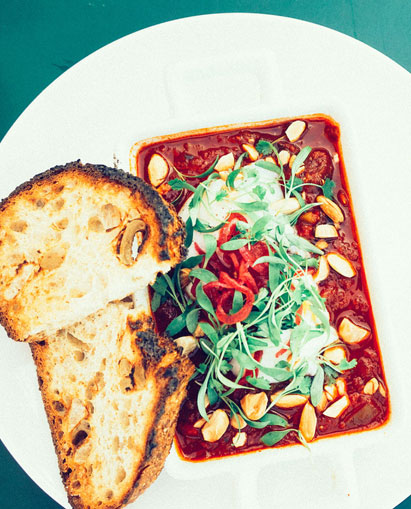



Want some hacks that will instantly make your food photography look more DELICIOUS?

Everyone seems to have that one hack they know nobody else knows. For instance, it could be that super secret way you pack all your clothes to fit your luggage. Or it could be, like mine, putting crumpled newspapers in your shoes to eliminate smells.
Whatever your hack, I bet it’s something that you know would instantly help others improve whatever they’re struggling with. And it’s the same with photography. Every professional photographer has his or her own ways of getting the best out of their gear and their subject.
For photographing food, this means learning specific ways to make the viewer hungry and weak at the mouth. Crazy talented food photographers know how to get inside your head and make you realize you actually do like roasted garlic glazed with a middle-aged balsamic vinegar and a side of couscous.
They make you SALIVATE for a something you’ve never tried or tasted before.

But if it was something so hard to understand or impossible apply to your work, I wouldn’t be writing this email. Photographing FOOD is all about revealing those slight changes to your approach that you must know. It’s about giving you the hacks only those-in-the-know, know.
It’s the tricks, techniques, and theory about photographing food look like it was conjured in heaven and delivered to your screen. In it, you’ll learn all the DIY lighting modifiers and backgrounds, all the colors to attract interest and appetite, and all the ingeniously clever lighting setups to make deliciousness commonplace.
Now, put down those overhead iPhone shots. Study these pages and let’s start taking some amazing food photography.
Photographing FOOD: Issues 1- 8
 8 ebooks in one. 294 total pages.
“Color is a vital part of food photography. It is a key component in communicating a message to your viewer. The vibrant red of a tomato lets you know that it is ready to pick. The bright orange of a habanero is a warning to be cautious about what you are about to eat. The rich greens of kale signals that it is loaded with nutrients. These are only a few of the thousands of messages that the color can help communicate about the food we eat.”
Do you what primary colors are? What about secondary colors? How about tertiary colors? Complementary colors? Split complementary colors? Did you know how these different hues, tints and shades, combine and contrast is just as important to a successful food photography as the lighting?
Well, maybe not as important, but it’s certainly a close second. You’ll learn all the techniques and theories about making sure you understand exactly what color means to engaging the primal, instinctual hunger deep inside us.
 Here’s a quick breakdown of all the ebooks:
Window Lighting: Book 1 is all about DIY. You’ll learn how to build your own diffusers, tungsten studios, and white on white backgrounds. And, at the end, you’ll be able to mimic food-coma inducing window light.
Color & Camera: Color theory and how that applies to food. You’ll learn what colors go with what dish and learn how to angle your camera for the most impactful, traditionally successful, food-specific shots.
Shooting at Night: You’ll learn how to light food photographs at night, so you don’t have to rely on pesky restaurant opening hours. You’ll adapt your lighting workflow, either with flashes and gels, or hot lights, to food photography.
Ingredient & Process Shots: You’ll learn how to make mouthwatering shots of the ingredients and the cutting process, not just the finished meal. You’ll learn with Macro lens and creative shutter speed tricks.
After the Shot: Editing it all together. You’ll effective Lightroom and Photoshop techniques you need to learn for food photography.
Outdoors and Travel: Ever been to the farmer’s market at midday? Not the best light. This ebook is about learning how to adapt your food photography to the streets.
Backgrounds: How do you take advantage of what you put your plate on? You’ll understand the best ones and the weakest ones. You’ll also learn how to build your own stain woodwork and mock countertops. Home Depot time!
Modifying Light: The mothership. The ebook that ties everything together. You’ll learn how to make light the best ingredient in any dish you’re photographing. You’ll get Indirect Bare Lighting, Direct Diffused Lighting, and understand how to capture the best shadow and contrast for each Food Photography dish.

Reviews
There are no reviews yet.